
A distributor’s godown, an e-commerce hub and a factory warehouse all need a clear picture of goods and movement. Lensgate can help teams follow receiving, storage and dispatch activity without spending the day searching through recordings.
Goods receiving counts
The problem
Staff rely on manual tallies as cartons enter the receiving area.
Our solution
We can count defined visible units crossing an agreed point and organise the movement record for receiving-team review.
Truck loading and unloading
The problem
Cartons move in both directions during dispatch, and the final tally is difficult to reconstruct.
Our solution
We can record visible loaded and unloaded crossings and help the dispatch team compare the session with its shipment list.
Blocked aisles and passages
The problem
Pallets, cartons and trolleys are left in marked pedestrian or service routes.
Our solution
We can flag a visible obstruction that remains in an agreed zone and send it to the responsible supervisor.
Forklift and pedestrian zones
The problem
The supervisor needs better visibility of activity where people and material-handling vehicles share a view.
Our solution
We can highlight defined zone events and vehicle–pedestrian activity for the team to review.
Visible pallet movement
The problem
It is hard to trace when pallets pass between selected storage and dispatch areas.
Our solution
We can create time-stamped events at agreed transfer points and link them with available operational references.
After-hours zone activity
The problem
The team wants a clearer record of movement in selected areas outside regular operating periods.
Our solution
We can generate zone-entry events according to agreed timing rules and route them to a responsible reviewer.
Dispatch-area congestion
The problem
Multiple vehicles, loaders and cartons compete for space around busy bays.
Our solution
We can show occupancy and visible movement at selected bays to help supervisors coordinate loading activity.
The process, in pictures.
AI-generated illustrative photos of a proposed workflow.
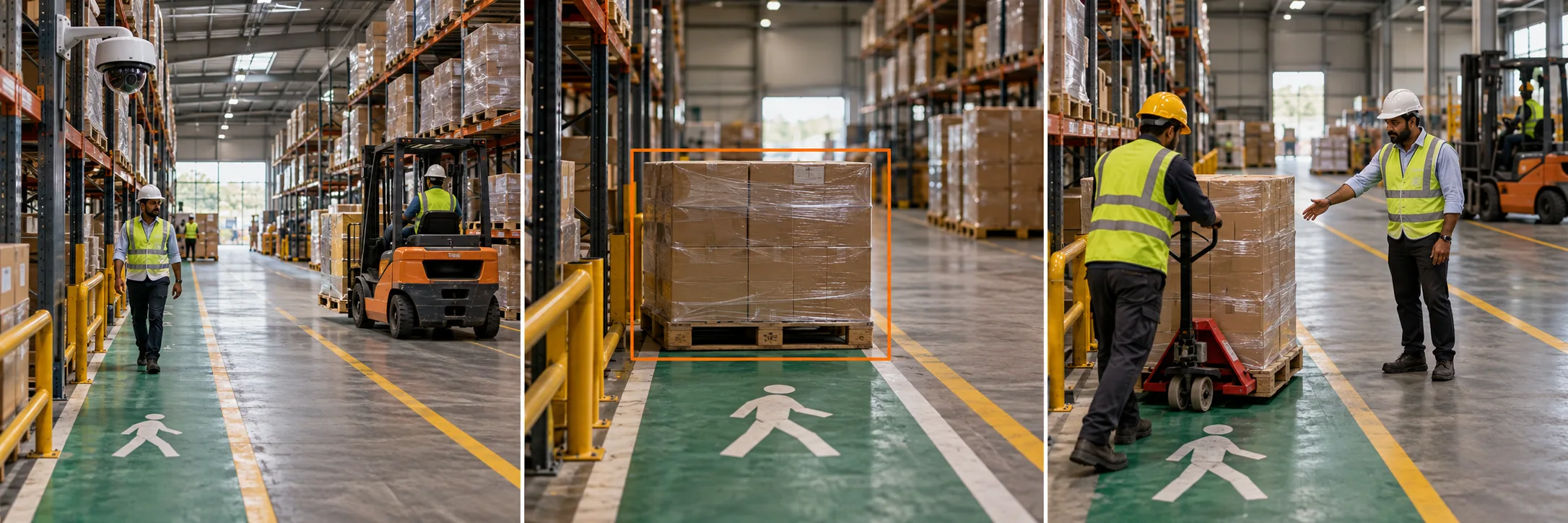
Look at the operating area
A selected view shows storage, pedestrian routes and material movement.
Spot the event that needs attention
The example highlights a pallet blocking a marked walkway.
Give the supervisor a useful signal
The team reviews the obstruction and coordinates the next action on the floor.
Which problem would you solve first?
Tell us about your establishment, the cameras you have and the process you want to improve. We’ll discuss a practical solution for your team.
Discuss your requirements ↗